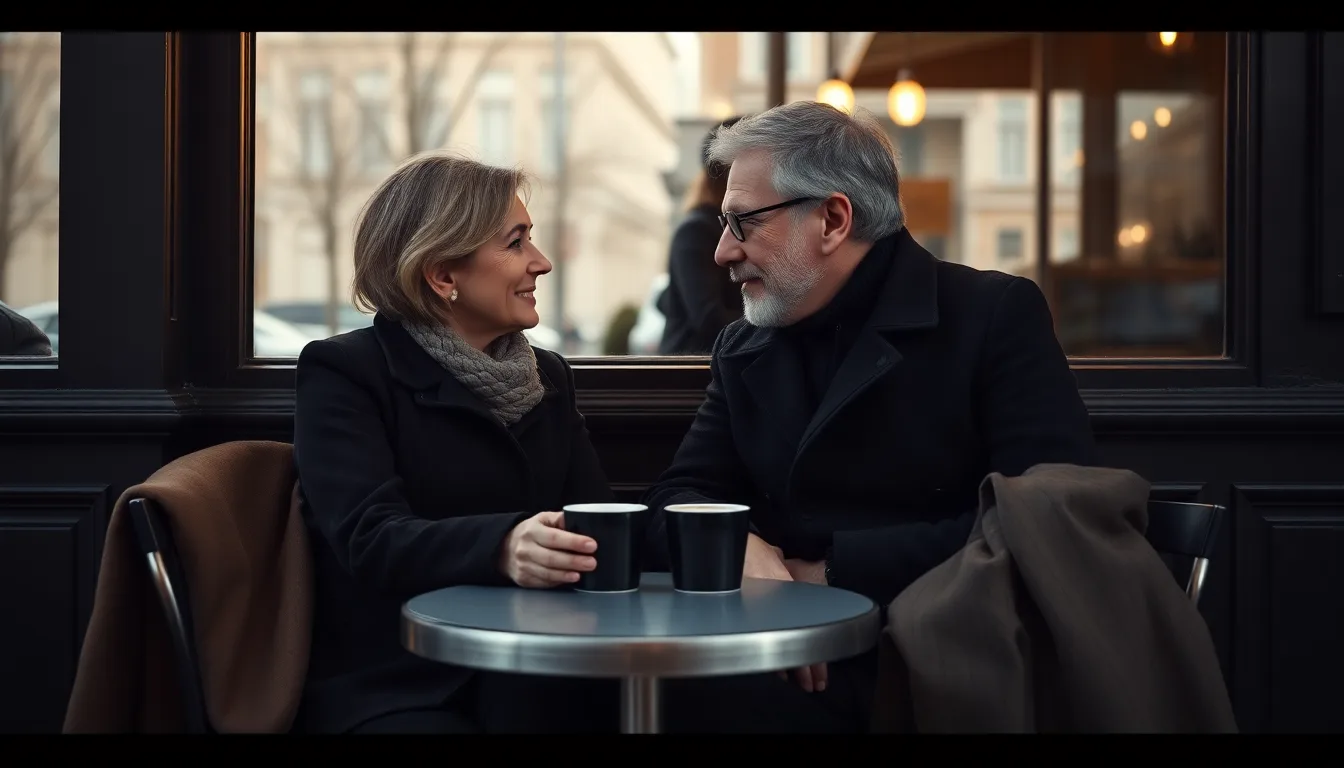
The first time Claire and Tomas broke up, it was in the stairwell of a university flat in Utrecht, in April 1994. She was twenty-two. He was twenty-three. He was moving back to Lisbon for a job that in retrospect wasn't worth the move, and she was finishing a dissertation she mostly hated. They cried, briefly. They promised they'd stay in touch, and they didn't, because in 1994 staying in touch required effort neither of them had the currency for.
They each married other people. Claire had two daughters. Tomas had one son. Both marriages lasted long enough to be serious, and both ended — hers in 2019, his in 2015. Neither of them thought of the other more than a few times a year, and when they did it was fondly, the way you think of a good song from a specific summer.
In December 2024, three weeks before Christmas, Claire was on Viyamore during what she calls "the depressing part of a Tuesday evening" and swiped past a profile that stopped her. The photo was of a man in a dark coat in front of a blue door in what was very clearly Lisbon. The first name was common. But the eyes were not.
She matched him, and wrote four words: "Tomas, is that you?"
What She Wrote Next
Tomas tells the story of that message with a very specific kind of smile. "I was eating bad leftovers. I opened the app. I thought someone was making fun of me. Then I looked at her photo, and I was twenty-three again, and also fifty-three, which is a very strange thing to be at the same time."
He wrote back a longer message than he usually would. Three paragraphs. He tells me that he tried to sound casual and failed. Claire tells me she could tell, immediately, from the paragraphs, that he had not changed in the ways that mattered.
They moved to an actual phone call within four days. The call was two hours. They agreed to meet in Amsterdam in late January.
The First Meeting, Thirty Years Later
"We had both been warned by friends not to do it," Claire says. "Everyone thought we'd be disappointed. They thought we were chasing a ghost. I remember telling one of my daughters, 'I know who he was at twenty-three. I want to see who he is now.' She said, very kindly, 'You might not recognize him.'"
They met at a cafe near Amsterdam Centraal. Claire took a train up from her town. Tomas flew in from Lisbon and took the train from Schiphol. They had agreed to meet at the cafe for coffee, leaving the rest of the day open.
"I recognized him before he saw me," Claire says. "His hair was grey, and his jaw had changed, and he walked slightly slower than he used to, but his posture was the same. He still carries himself the way he did in 1994. I don't know how to explain it. You know a body you loved for a long time even thirty years later."
They spent seven hours at that cafe. They took one walk to another cafe when the first one closed. They didn't eat dinner, because they forgot. Tomas changed his return flight twice.
What Actually Worked About It
I asked both of them, separately, why this worked when they'd both had failed marriages in the intervening decades. They each gave me different answers, which together formed a full one.
Claire: "We're both different people now than we were. That's the obvious one. But also — I'd gotten very good, over the last five years, at noticing when I wasn't being listened to. My ex-husband was charming, and he was never listening. Within the first hour with Tomas, I noticed he remembered every small thing I said. He'd bring it back up twenty minutes later. Not to perform. Just because he'd been there."
Tomas: "I spent my forties being exactly the person my ex-wife needed me to be, and being very unhappy in a very specific way. Talking to Claire again, I noticed I didn't have to translate myself for her. She understood the shape of me. That is a thing I would not have valued at twenty-three, because at twenty-three you take it for granted."
"You marry the wrong person at twenty-five," Claire said, "because you don't yet know which translations cost you. You recognize the right person at fifty-three because you finally know what it feels like not to have to translate."
The Practical Middle
They are not sixteen. The logistics are not dramatic, they are real.
Claire lives in a small Dutch city. Tomas lives in Lisbon. Both of them have adult children with roots where they are. Neither is going to uproot fully, at least not yet. They've done a year of deliberate back-and-forth — two weeks together, two weeks apart, alternating cities, both of them lucky enough to have work that tolerates the flexibility. Claire's daughters have met Tomas twice. His son has met Claire once, with deliberate slowness.
"We're not fifteen," Tomas says. "We have lives. If you ask me if we'll be in the same city by year three, I don't know. Maybe. Maybe not. We've been clear with each other that we would like to, but we are also not betting the house on it tomorrow."
Claire: "I was married in the way you're married when you're young and scared. I'm not going to do that again, even with him. The thing we do now — some weeks here, some there — is not a placeholder for the real thing. For us, right now, this is the real thing."
What They'd Tell Someone Reading This
I asked them if they had advice for someone who had seen a ghost from their past pop up on a dating profile. Claire said yes, immediately.
"Match them. Even if you think it's nothing. The downside of matching someone from thirty years ago and having an awkward coffee is approximately zero. The upside, in a rare case, is this."
Tomas pushed back slightly, gently. "I'd add — don't confuse recognition with compatibility. We recognized each other in January. It took another five months to find out if we were actually still compatible as fifty-year-olds. A good first meeting is not enough. The work of finding out if it will hold is the same as with any new relationship. We just had a different starting point."
The Odd Gift of the Gap
Something I noticed, sitting with them in a small Lisbon apartment with very good coffee and a cat that ignored me: they don't try to pick up where they left off. They are both clear that the twenty-two-year-old Claire and the twenty-three-year-old Tomas are not the people in the room. Those two went their separate ways and built their own lives, and those lives have produced the people now sitting on the couch.
"It is like meeting a stranger who speaks your first language," Tomas said. "He is still a stranger. But you don't have to learn a new alphabet."
Claire laughed at that one. Then she said, more softly, "We're also both clear we're not trying to redo our twenties. Our twenties were not that great. We had a sweet summer and a hard winter and we broke up for a reason. What we have now is something we would not have been able to have at twenty-three. It needed the thirty years."
Which, I think, is the real shape of the story. Not two lovers finally reunited. Two people who knew each other at the beginning, lived separate full lives, and were lucky enough — and patient enough — to recognize each other, in the right way, at the right moment, thirty years later.
The cat still ignored me when I left.