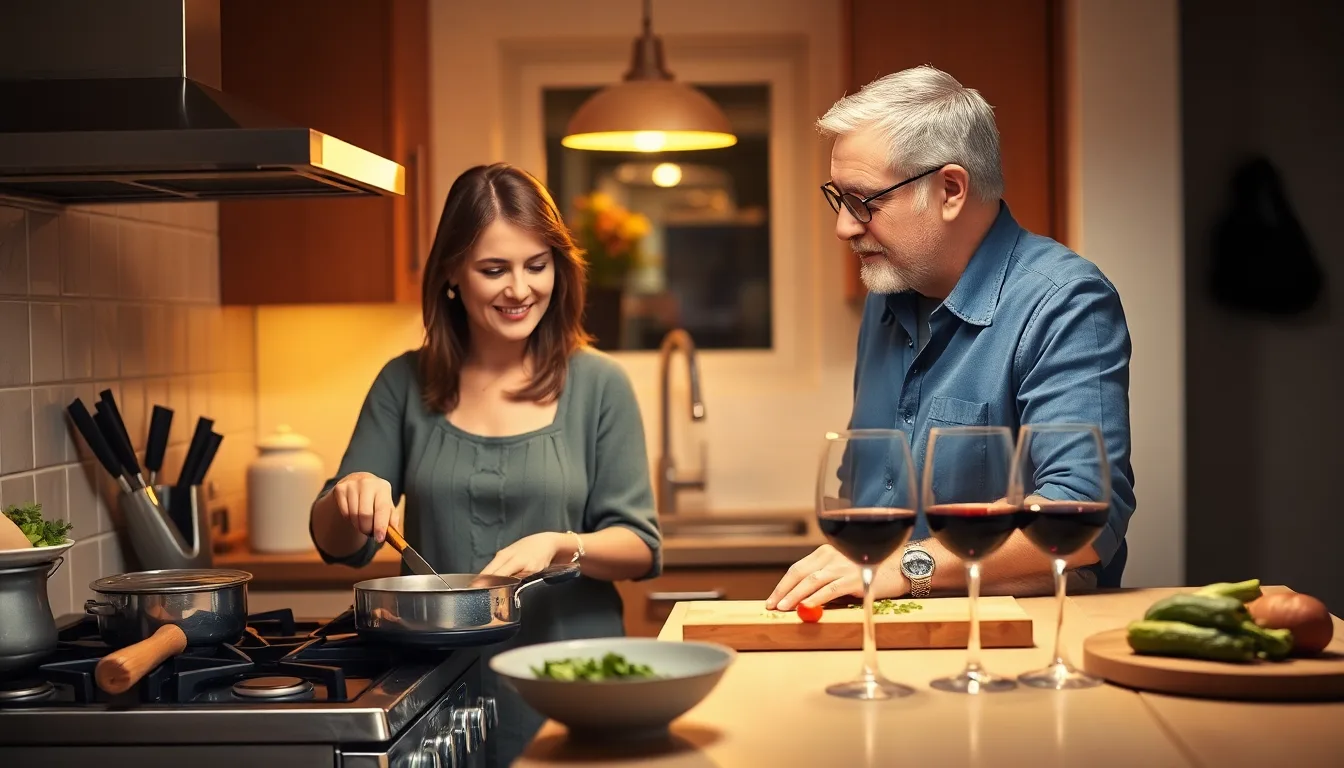
A Wednesday evening in late March. A small kitchen, warm from the oven. He is trimming green beans at the counter; she is at the stove adjusting the heat under a pan of olive oil. The radio is playing something neither of them would have chosen individually but both happen to like together. They are not talking, particularly. Every few minutes one of them says something small and the other answers. The cat has correctly identified that the pan contains chicken and is positioning herself for opportunity.
This is one of the quietest, most durable forms of love available to adults. It is not cinematic. It does not photograph well. You would not use it as the promo image for a romance. It just works, decade after decade, better than almost anything else we could do with our evenings.
Why Cooking Together Beats Going Out
A restaurant date has a plot. You arrive. You sit. A waiter interrupts. You order. You talk for forty-five minutes. You pay. You leave. Ninety minutes, with a defined beginning and end, and most of them involve sitting across from someone looking at them.
Cooking together doesn't have a plot. It has a rhythm. You come home. Someone opens the wine. Someone starts chopping. Someone adjusts the music. Your shoulders are tired from the day, so you are not trying to be charming. You are trying to remember whether the garlic is already going in or not yet.
The form of attention involved is different. You are beside each other, not across. You are doing something together, not watching each other. Conversation happens in bursts and pauses. Silence is allowed, even welcome. This is, for adults who have spent long years performing attention in other contexts, genuinely restful.
The deepest intimacy in a mature relationship often happens shoulder-to-shoulder, not face-to-face.
The Specific Intimacies of a Shared Kitchen
A few things that happen reliably in couples who cook together a lot:
You learn their rhythms under small pressure
Cooking is low-stakes pressure. A pan is getting hot. A timer is running. Something needs salting. How does your partner behave when the soup is about to boil over? Do they ask for help? Do they panic? Do they try to do everything themselves and miss the moment you were about to hand them a plate?
These are miniature versions of how they'll be when bigger things get hot. You are calibrating each other, gently, over garlic.
You develop a non-verbal choreography
After a few months of cooking together, a kitchen dance emerges. One of you reaches for the cutting board without asking, because you've read that it's about to be needed. One of you knows, without looking, which drawer has the grater. One of you moves to the left so the other can reach the stove. This is, at the nervous system level, one of the most intimate things two bodies can do together without touching.
You earn the right to argue gently
You will have kitchen disagreements. About salt. About how long the pasta should sit in the sauce. About whether the bread is still good or is clearly past it. These arguments are the training ground for bigger disagreements. Couples who can disagree about the onions, affectionately, without hurt feelings, have a blueprint for disagreeing about money three years later.
You share one completed act of ordinary making
At the end, there is a meal. The two of you made it. It was not takeout. It was not a restaurant. It was a small, ordinary thing you two built together, tonight, that will be gone in forty minutes. That is, if you let it be, surprisingly moving.
The Mistake New Couples Make
Couples who want to cook together but haven't yet made it a habit often start with the wrong meal. They try to make something ambitious. A complicated recipe. Eight pages of instructions. Three pans at once. A specific wine.
Don't. The first few cook-together evenings should be the easiest meals either of you knows how to make. Grilled chicken. Pasta with a simple sauce. A big salad. Something that takes thirty to forty minutes and forgives small errors.
The point is not to make an impressive meal. The point is to be in the kitchen together comfortably. Ambition is the enemy of comfort. Build the comfort first. The ambition can come in year two, if at all.
Division of Kitchen Labor
Something worth naming early: the division of labor in the kitchen is not neutral. Many couples, especially those coming out of long first marriages, have inherited roles they haven't examined.
One partner is used to being the cook. The other is used to being the eater-and-praiser, or the washer-up. In a new relationship, you have a chance to rearrange these. Talk about it, don't default.
A good model: whoever cooks, doesn't clean. Whoever doesn't cook, cleans. This is simple, fair, and prevents the most common kitchen resentment. If one partner does everything, including both cooking and cleaning, that partner is, over time, going to get quietly angry, even if they're the one who said "I love to cook."
Specific Rituals That Work
A few cooking-together rituals that couples consistently report as staples of their second chapters:
- The Sunday roast. Or Sunday stew. Or Sunday curry. A big meal, built slowly, on a quiet afternoon, that will feed you through midweek leftovers. The slowness is the feature.
- The weekday experiment. Once a month, pick a new recipe neither of you has made. Go shopping for it together. Make it. Talk about what you'd change next time.
- The friend-over Saturday. Invite one couple. Cook together for them. Don't try to impress. Make something you've both made before. This turns the kitchen into the living room and is more fun than any dinner party you've attended.
- The comfort-food recovery meal. Every relationship needs the meal you make when one of you has had a bad week. Simple. Warm. Known. Tomato soup and grilled cheese. A soft pasta. Whatever it is in your shared vocabulary, name it and keep it available.
The Music Question
Small, but important: build a shared kitchen playlist. Not your separate music. A third thing. Some songs he likes. Some songs she likes. Some songs you both discovered together. Forty songs. Put it on when you start cooking.
After a year of cooking to the same forty songs, you'll have built a private soundtrack to your ordinary evenings that neither of you had before. That soundtrack becomes, quietly, one of the small anchors of the relationship. It's a reliable thing that belongs only to the two of you.
When One of You Doesn't Actually Cook
This happens. One partner genuinely doesn't cook, isn't going to learn, and is honest about it. That's fine. It doesn't mean cooking together is off the table. It just means roles look different.
The non-cook can still be in the kitchen. Pouring wine. Washing the lettuce. Setting the table. Stirring what needs stirring. Keeping the cook company. The act of being in the kitchen together, even with lopsided technical skills, is almost all of the benefit.
What doesn't work: the non-cook watching television in the next room while the cook works alone. That reproduces the older marriage dynamic many people are trying to escape in a second chapter. Don't let it rebuild itself accidentally.
One Small Thing to Try This Week
Pick a Wednesday. Agree to both be home by seven. Pick something genuinely simple to make — a pasta, a stir-fry, a roast chicken and potatoes. Put on a shared playlist. Pour two glasses of wine or whatever you both drink. Cook it together.
Don't photograph it. Don't post it anywhere. Don't turn it into an event. Just make dinner, together, for one ordinary night.
Then do it again next Wednesday. And the one after that. Within two months, you will look up at a pan of hot oil and realize that the person across the kitchen feels more like a partner than they did eight weeks ago. You will not know exactly when it happened. That's the whole quiet point.